SF Climate week - energy from space panel
The grid needs power that never stops. What if the answer is 100 miles up?
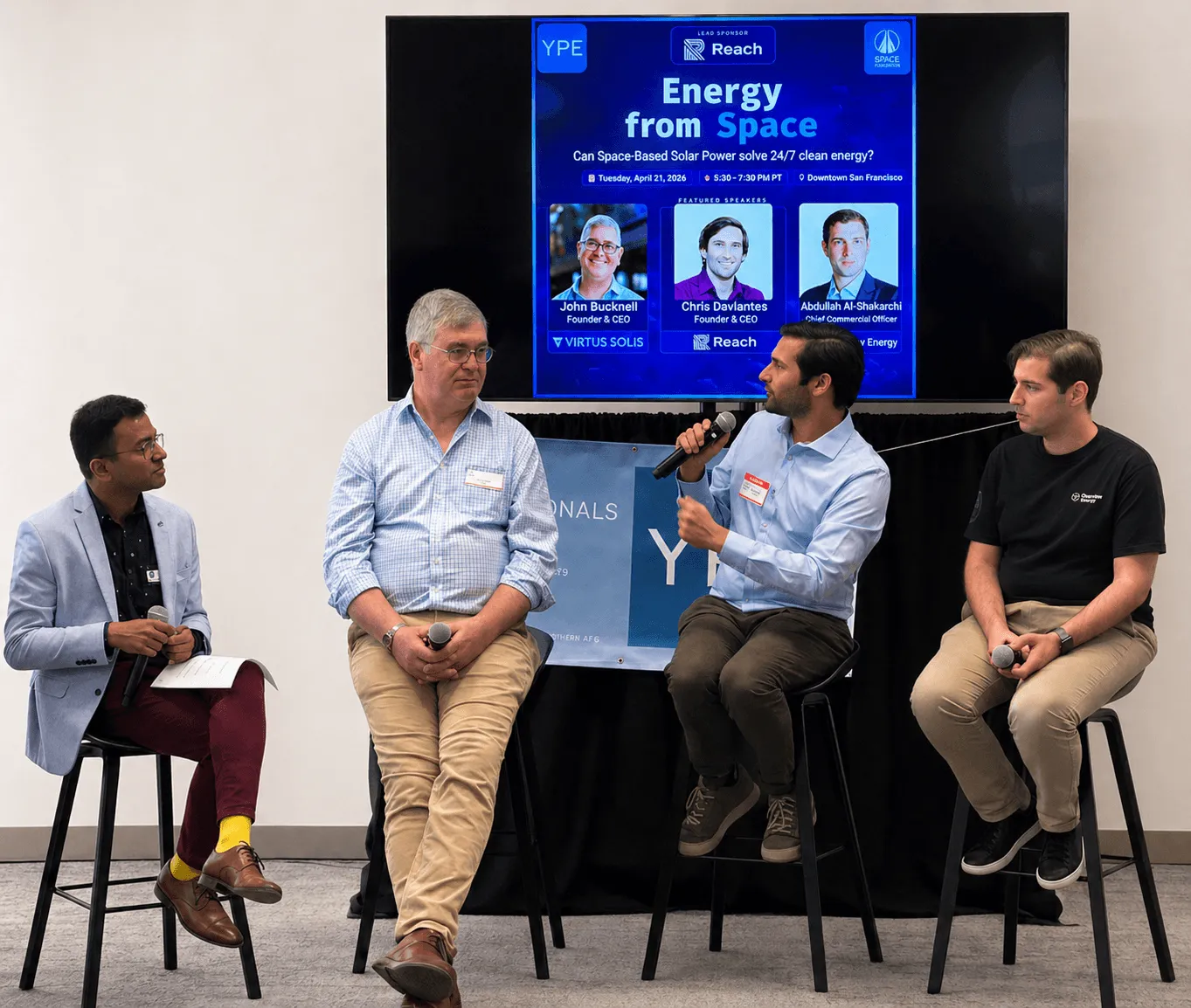
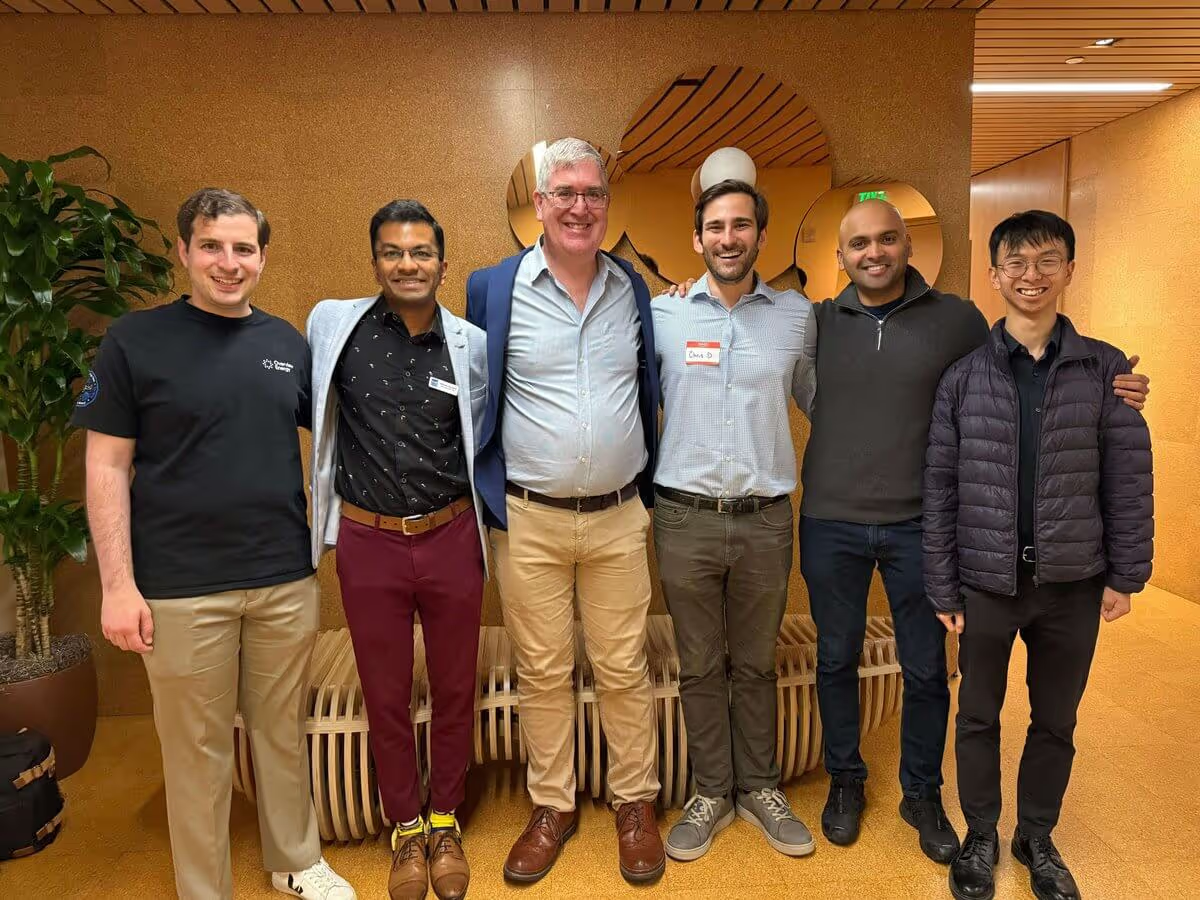
On April 21, YPE SF Bay Area and the Space Frontier Foundation hosted Energy from Space, a panel discussion on Space Solar Power (SSP), sponsored by Reach Power, as part of SF Climate Week 2026. The event brought together ~60 energy, climate, venture, and policy professionals for a technically grounded conversation on whether SSP can deliver firm, 24/7 clean energy — and what it would take to get there.
Key Takeaways
The panel made clear that Space Solar Power is no longer theory — it’s commercial. John Bucknell, Founder & CEO of Virtus Solis Technologies, walked us through microwave-beaming satellite architecture and revealed that Virtus Solis signed terms for its first 500MW deal, with a pilot deployment targeted within 24 months. Abdullah Al-Shakarchi, Chief Commercial Officer of Overview Energy, shared how near-infrared laser transmission from geosynchronous orbit can power existing solar farms at night, with a megawatt-class commercial satellite launching in 2030. Chris Davlantes, Founder & CEO of Reach Power, explained how AI-driven wireless power transmission networks already work today, powering robots, drones, and defense deployments with a NASA relay launch planned for 2027.
On safety, the systems use triple-redundant cutoffs and operate within existing FCC standards, with power density no more intense than Wi-Fi at utility scale. On economics, SSP is costs competitive with nuclear, solar-plus-storage, gas peakers and with most expensive marginal generator. For grid operators, no infrastructure changes are required — solar farms simply begin generating at night. The most powerful idea to emerge from the discussion was geographic dispatchability — the ability to redirect energy across continents in seconds, covering demand peaks anywhere on the planet, which no terrestrial generator can match. For the energy community, the ask was direct: find near-term applications, push for public pilots, and engage early — the first real-world demonstrations are 2 to 3 years away. Space solar energy is capable of powering 10 to 20% of the planet by 2050.